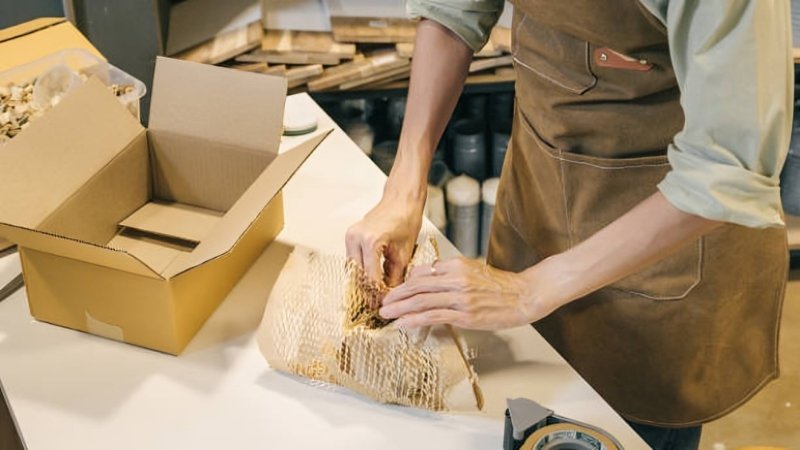
Expanding a retail business does not imply constructing more infrastructure. Lease more storage, recruit more workers, and acquire more machinery is what most operations managers tend to do when demand increases. This is costly, and for the most part, not needed. Instead, you should put an end to considering your packaging line as one of your core competencies and start perceiving it as a variable expense.
Fixed Costs Are The Ceiling, Not The Floor
Here’s the uncomfortable truth about running packaging in-house: the cost structure works against you almost by design. Your warehouse lease doesn’t care that February is slow. That case sealer you bought to keep up with the Christmas rush? It sits there in March costing you money whether it’s running or not. You’re essentially paying for capacity around the clock, even during the stretches where it’s doing nothing.
What actually needs to happen – and what a lot of growing retail brands eventually figure out – is a shift away from owning that capacity altogether. Rather than carrying the fixed overhead, you pay per unit. Sounds simple, but the knock-on effects are pretty significant. A bad quarter stings a lot less when you’re not also staring down idle machinery and a payroll you can’t easily trim.
There’s some decent data backing this up too. According to the 2023 Annual Third-Party Logistics Study, 71% of shippers reported lower logistics and packaging costs after they started outsourcing. That’s not a rounding error – that’s a fundamental change in how money leaves the business.
The Variable Model In Practice
Making this shift means identifying which parts of your packaging workflow are labor-intensive, seasonal, or highly specialized – and moving them off your headcount. Secondary packaging, kitting, and promotional bundle assembly are the usual candidates. These tasks look simple on paper but consume enormous amounts of floor space and coordination when you’re doing them at any real scale.
Partnering with co packing services gives retail brands the ability to scale output during seasonal peaks without hiring temporary warehouse workers or purchasing wrapping machinery they’ll use for eight weeks and store for the rest of the year. The infrastructure already exists. You’re accessing it per unit, not buying it outright.
This also removes the staffing variability problem. Labor shortages hit hardest when demand spikes, which is exactly when you can least afford a slow line. External partners maintain trained teams and automated equipment as their core business. That’s their job. Your job is moving product.
Standardize Before You Outsource
Before a third party can effectively run your packaging, your packaging design has to be somewhat sensible. SKU proliferation is one of the biggest drivers of high packaging costs – too many box dimensions, too many custom inserts, too many one-off configurations that require a manual judgment call at every station along the line.
SKU rationalization is something that’s worth undertaking before you outsource anything. Do a packaging configuration audit and figure out where you can consolidate. Simply standardizing box dimensions across product families will reduce material procurement costs. Universal inserts and shared components across SKUs will reduce changeover time at the packing station, whether that station is yours or a partner’s.
Simpler packaging is also more automatable. If your product requires a custom fold and three manual tuck points, no automated cartoner is touching it. If it fits a standard configuration, you can run it through equipment you’d never be able to justify purchasing yourself.
Access Automation Without The Capital Expenditure
Certainly, high-speed packaging automation such as flow wrappers, automated case sealers, and robotic palletizers can help elevate your packaging operation to the next level. The increased speed and efficiency such machines afford can make a real difference to a business looking to maintain or even increase throughput while keeping labor costs in check.
However, the truth is that for most mid-sized retailers, the capital expenditure required to purchase, install, and maintain this kind of equipment can rarely be justified. The volume required to make your money back on the equipment demands both sustained and predictable volume – and that’s not a guaranteed reality for most growing retail brands.
Align Your Packaging Runs With Actual Demand
One often-overlooked expense is paying to store excess packaging materials at a warehouse. Custom boxes with your branding, specialty inserts, printed tissue, etc., are ordered in minimums based on the price – not what you’ll actually go through before changing the design or discontinuing the product.
Taking a just-in-time approach to packaging materials means having procurement decisions rely on sales data rather than optimism. When your packaging runs are scheduled with a partner who has access to your inventory levels and order flow, you won’t order six months’ worth of boxes to hit a price break that you won’t miss.
It might take a bit of effort to get your systems to sync up, but real-time inventory integration between your world and your packaging partner’s world does exactly what it says on the tin and breaks the cycle of having too much packaging for one SKU while running out for another.
Scaling doesn’t require owning more of the supply chain. It requires being strategic about which parts of it genuinely need to be yours.

Lucas is a writer at Magazine Outstanders, with 3 years of experience covering business, technology, health, and lifestyle topics. He specializes in turning complex ideas into clear, well-researched, and engaging articles that keep readers informed and inspired. Driven by curiosity and a passion for storytelling, Lucas strives to deliver content that is accurate, valuable, and easy to connect with.