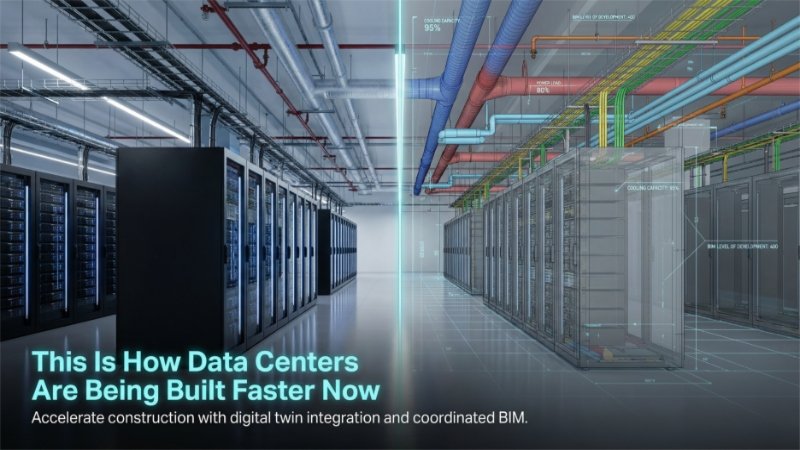
The Data Center Boom Is Raising the Bar for MEP Design
The world is building data centers at a record speed. Hyperscale demand is rising. So is edge expansion. And the pressure to deliver faster, cleaner, and more reliably has never been higher. In this environment, MEP BIM services are no longer nice-to-haves. They are becoming the baseline for modern data center delivery.
What makes data centers different is not just scale. It is the density. Mechanical, electrical, and plumbing systems are packed into tight zones. Power and cooling are layered. Redundancy is non-negotiable. Every inch counts. And a single coordination miss can ripple across the entire facility.
Traditionally, MEP design relied heavily on 2D workflows. Teams worked in parallel. Conflicts were often discovered late, during shop drawing review or, worse, in the field. That approach does not hold up in today’s data center landscape. Schedules are shorter. Budgets are sharper. Owners expect certainty early. This is why MEP delivery is changing. More teams are moving toward model-first coordination. More stakeholders want constructability insight before construction begins. And more owners want confidence that systems will install cleanly, commission faster, and perform as intended.
In short, the bar has moved. Data centers are evolving. And MEP design has to evolve with them.
What Are MEP BIM Services and Why Do They Matter for Data Centers?
MEP BIM services bring mechanical, electrical, and plumbing systems into a coordinated 3D modeling workflow. For data centers, this is not optional anymore. It’s a practical way to reduce risk and increase build certainty.
Here’s what MEP BIM services actually include, and why they matter:
Why are they essential in data center projects
- MEP dominates data center design: Power and cooling systems take up most of the building volume and budget.
- High-density zones leave no room for error: Conflicts in ceiling spaces, electrical rooms, or plant rooms can cause major redesigns.
- Redundancy requirements raise complexity: Systems like N+1 and 2N increase routing, equipment count, and coordination pressure.
- Schedules are compressed: Owners and contractors need coordination resolved early, not during construction.
- Stakeholder coordination is intense: Architects, MEP engineers, BIM teams, GCs, and vendors must align fast, and BIM provides a single coordination reference.
- Performance expectations are non-negotiable: The facility must install cleanly, commission efficiently, and operate reliably from day one.
MEP BIM services turn MEP delivery from a set of parallel drawings into a coordinated, buildable, and installation-ready model, exactly what data center construction demands today.
Why Traditional Coordination Fails in Data Center Projects
Data centers move fast. Their MEP systems are packed into tight spaces. Traditional coordination can’t keep up.
- Too many systems share the same routes
Power, cooling, piping, and fire protection all run through the same ceilings and corridors. - Conflicts are found during construction
In many projects, issues surface only when trades start installing.
Which is why following best practices for MEP clash detection in BIM workflows becomes critical to resolving coordination issues before they reach the field.
- Fixes aren’t small in the real world
One re-route can trigger rework, material waste, and sequencing changes. - Redundancy multiplies coordination load
Backup systems add more equipment and pathways, increasing the chance of overlap. - Field teams end up solving design problems
That leads to RFIs, delays, and cost overruns.
Traditional coordination was built for simpler buildings. Data centers demand early alignment and high certainty.
Key BIM Deliverables Data Center Owners and GCs Should Expect
If you’re an owner or a general contractor, you don’t need “a model.” You need usable outputs. Deliverables that help teams coordinate faster, build cleaner, and hand over better documentation.
Here are the BIM deliverables that matter most on data center projects:
- A coordination-ready 3D model- A single view where major MEP systems align and can be reviewed together, especially in tight zones.
- Clash reports with clear resolution tracking- Not just a list of issues. A system that shows what was fixed, what is pending, and what needs owner approval.
- High-risk area coordination packages- Focused model views and layout sheets for congested locations like corridors, risers, ceilings, and plant rooms.
- Installation-ready routing layouts- Models and drawings that trades can actually follow so routing decisions aren’t left to the field.
- Prefabrication support outputs- Clean model data that helps teams plan assemblies, spools, and fabrication with fewer revisions.
- BIM-based as-built documentation- Final records that reflect what was installed, not just what was designed. This supports commissioning and future upgrades.
- A structured digital handover package- Organized model files, drawings, and system information that operations teams can use long after the project is complete.
For data centers, deliverables are not about checking a box. They are about protecting uptime, schedule, and long-term performance. The right BIM outputs make that possible.
How to Choose the Right MEP BIM Partner for Data Center Projects
Not all BIM teams are built for data centers. These projects are fast, dense, and unforgiving. The right partner won’t just model systems. They will help teams coordinate smarter and build with fewer disruptions.
Here’s what owners and GCs should look for:
- Proven experience in mission-critical environments
- Strong MEP coordination capability, not just modeling
- Ability to handle high-density zones
- Clear clash detection process
- Speed without sacrificing accuracy
- Outputs that trades can actually use
- Clean handover and documentation standards
The right MEP BIM partner reduces uncertainty. They make coordination predictable. And that is one of the most valuable advantages in data center delivery today.
The Bottom Line: Why MEP BIM Is Now a Data Center Necessity
Data centers aren’t getting simpler. They’re getting larger, denser, and more schedule-driven. Power and cooling systems are expanding. Redundancy is increasing. And owners want faster delivery without sacrificing reliability.
That reality makes one thing clear. Traditional coordination is no longer enough.
MEP BIM is now a necessity because it brings predictability to a process that is otherwise high-risk. It helps teams resolve conflicts earlier. It supports smoother construction. And it improves how facilities are documented and managed after handover.
For owners and general contractors, the value is straightforward:
- Fewer delays
- Fewer expensive changes
- Better coordination across trades
- Cleaner turnover for long-term operations
In the data center world, speed matters. So performs. MEP BIM helps deliver both.

Lucas is a writer at Magazine Outstanders, with 3 years of experience covering business, technology, health, and lifestyle topics. He specializes in turning complex ideas into clear, well-researched, and engaging articles that keep readers informed and inspired. Driven by curiosity and a passion for storytelling, Lucas strives to deliver content that is accurate, valuable, and easy to connect with.